Tag Archives: knowledge

My Life is Hectic! (Here’s How I Deal)

My semester at school just started up on January 23rd and, despite being thrilled to be back, the change in schedule (and routine) has really thrown me for a loop.

This semester I have classes five days a week and I’m at the school until just after noon each day. Compared to my three-day school weeks I’ve been used to the last few semesters, I can certainly feel a difference. Going from a month vacation off from school to being at school every weekday is more difficult that I had imagined.

To keep myself (and my family) on schedule and as stress-free as possible, I employ a few methods to organize our week:

First, schedule. Schedule, schedule, schedule.

Since getting a smart phone a year ago, I’ve stopped using a paper agenda and instead have been using Google Calendar to keep track of my days.

Google Calendar is great for many reasons.

I can view, add and edit my calendar via my phone, as well as on any computer connected to the internet. When I enter an event, I can set a reminder to alert me 15 minutes (or other specified time) before the event.

I can invite someone to my event by entering their email. This is handy for event’s that a family member or friend should be aware of, for example, a Father-Daughter Dance.

I can also share my entire calendar with another Google Calendar user. My partner and I have both shared our calendars with one another. All of my events show up on his calendar coded in a different color then his (and vice versa).

This is helpful with kids, as he can see all of the activities and appointments they have scheduled, without my needing to individually invite him to each one.

I use Google Calendar in the same manner I used my paper agenda.

I write down all of the events that are static (class schedules, dance lessons, swim lessons, etc) and fill in any appointments or other events as I become aware of them. I also block off times for myself to work on homework, when class assignments are due, when I need to pick a child up early, etc.

I even use the calendar to remind me of things that need to be done, such as “Clean cat litter” or “Call to make appointment” so I don’t forget.

Second, I get as much I can done the night before.

We pick out clothes the night before in our house because mornings are hectic enough without worrying what you’re going to wear. And having two daughters only makes that trickier.

Each of my daughters picks out what they want to wear before going to bed each night. Before I go to bed, I do the same.

The rule is that what you pick out, is what you wear. When I started this, I said the rule upfront to both of my daughters. After a week, picking out our clothes the night before started to become part of our daily night-time routine. And it saves SO much time and drama in the morning.

Of course, you might end up with this. But remember, what you pick out is what you wear!

Anything else that can be anticipated needing to be done for the morning is also done the night before.

School lunches are packed and ready to go. Notes, permission slips and the like are signed and filed away into backpacks.

Homework is always completed the night before and everything needed for school is packed into backpacks as well. This includes me, as I’ve likely been guilty of forgetting items needed for school more times than my daughter.

Third, planning.

Yes, I know it seems like it could be categorized under schedule. But, trust me, planning isn’t quite the same thing (though they are intertwined).

The number one planning item is meals. After a long day at school/work/activities the last thing anyone wants to do is come up with what to have for dinner. I try to plan out two weeks of meals at a time.

I know some people plan out day by day, labeling X meal for Y day, but I can’t see doing it that way. What if I’m not in the mood for what’s planned? It’d very quickly throw the whole plan off.

Instead I plan out two weeks of main courses that I can then pick and choose from as I wish. Most of the time this is nothing more than a post it note and a list of meals.

This is an older meal plan. Back from when I still typed and printed them.

The one exception is Wednesday, which is our family’s busiest day of the week. On these days I try to plan an easy crockpot meal that I can quickly throw in the crockpot in the morning and come home to a wonderful smelling kitchen in the evening.

One of my favorite sites for crockpot recipes is A Year of Slow Cooking, which has some amazing (and easy!) crockpot recipes. I’ll likely go into further depth on my love of crockpot cooking in later posts.

Four, Breathe.

Being busy, being a student, being a mom and trying to be it all can be overwhelming. When everything starts to seem like too much, just take a break. Take a moment. Look at the sky. Count to 10. Take some deep breaths.

Take care of YOU.

It’s not going to be perfect. Ever. But sometimes all we need is a brief interruption of our steady swimming to stay afloat to realize that our heads our still above water and we can breathe.

————————————-
Obviously this isn’t an exhaustive how-to of juggling busy family life and stress (I didn’t even begin to cover procrastination).

But it’s a start. A change of any type will come with some added difficulty in the beginning but, with time and persistence, a new routine can be formed.

I know the next few months for me are going to be hectic and trying, filled with difficult courses and my self-imposed pressure to keep my high GPA (and that’s just my school stuff!). My goal throughout it all is to go easier on myself and enjoy the process as much as the outcome. Because it’s the journey that teaches us and inspires growth, not the destination.
Is There a Bigger Picture?

Recently it seems wherever I go there are people having a tough time. Having difficulty making ends meet, finding jobs, paying for all the expenses that somehow creep up at the worst possible times. Struggling with sicknesses, addictions, chronic illnesses like fibromyalgia, deep depression and other mental illnesses.

People are working their asses off at jobs they don’t enjoy, that they aren’t appreciated in or compensated for. Racking up large debts to pay for secondary educations with the foresight that there may not be careers available to them when they graduate.

Parents who are stressed out from all of these things and still need to find a way to hold it together to be the moms and dads their children not only require but also deserve. Losses of jobs and houses, and lifestyles and dreams. Losses of people, expected and unexpected, but felt just the same.

Religious arguments and politics. Social injustice. Internal feelings of inadequacy; of lacking. And an overwhelming feeling of despair and disappointment.

It all leads to, let’s be honest, feeling like shit. Feeling like the world is on your back. That bad things just keep happening and will just keep happening. That no matter what you do, it isn’t enough. It will never be enough. It might make you start questioning what the “bigger picture is.”

Is there a bigger picture? What is the point of all of this? And will it ever get any better?

I can tell you this, I don’t have the answers and I won’t try and act like I do.

Or rather, I don’t have the answers for you.

However, I have found the answers for me. Right now. In this moment.

Is there a bigger picture?

Do you want there to be? You are the captain of your life, whether you feel like it or not. In this moment, the bigger picture for me is this: Much of life has been beyond difficult, filled with trauma and tribulations and shit stacked so high against me that at many points I couldn’t see around it.

To be honest, my current life isn’t really any less difficult than it has ever been. But the bigger picture, for me, is that I can’t see having gone through all that I have and survived to just let my life be wasted. For me, the bigger picture is a trap. Looking too far in the future (or the past) blinds me from looking right here in the present, which is the only place I am truly capable of being in.

What is the point of all of this?

You know, I’ve mulled this question over since I was, at minimum, 15 years old. I haven’t ever come up with a definitive answer mainly because there isn’t one. There is no one answer to this question. The point of “all this” is whatever you want it to be.

Do you want to be the wealthiest person in the US? In the world? Do you want to discover an unknown entity or invent the world’s next innovation? Do you want to be the best parent you can be to your children? Do you want to be happy?

The meaning of life is vastly different for each person. For me, in this moment, the point of “all this” is to do the best I can. Right now. With the knowledge and resources and abilities that I have right now. And if tonight when I go to bed I realize that the day didn’t go as I had hoped or planned or even liked, well then tomorrow I will get up and try again.

Will it ever get any better?

At various times throughout my life I have been in places that, regardless of what anyone said to me, I would argue that no, it will never get better. I could point to the current place I was in (which was horrible). I could point to every past place of agony and depression and anger and despair. As if to showcase my evidence of how much everything is shit and always was shit and always will be shit. But, you know what?, complaining and arguing about how much my life sucked didn’t do anything other than allowing myself to sink down into it even more.

So, right here and right now, let’s lay it out. Life sucks. Life is hard and sometimes it seems like horrible things will never stop happening to us. Fair assessment?

Now let it go. Really. Putting the majority of your attention on all the things that are shitty, it doesn’t help you. While you’re busy getting stressed and upset about all the things that, right now in this moment, you can’t change you are missing out on all the wonderful things that are right there.

Sometimes all you can do is keep moving. Just keep waking up and doing the best you can. Just keep swimming as it were, like the fish in Finding Nemo.

Sometimes you need to change your perspective. To acknowledge the bad and let it go. To choose to focus on the positive things you do have in your life. To be grateful.

Are bad things going to keep happening? Yes. And good things too.

On Expectations & Disappointment

We all have expectations.

I expect the sun to rise each morning and set each evening. I expect that I will, in fact, wake up and be alive each morning. These kinds of expectations are generally not acknowledged as being an expectation since, it’s assumed by the majority of people that they will occur. They’re assumed events.

Then there are expectations that lessen our ability to see the choices and control in our lives. Many of these expectations we obtain through the course of our lives — through our childhoods, from influences of peers and authority figures, through exposure to situations, from the media and from familial and societal norms.

They may never be labeled as expectations. In many families there is an expectation that children will graduate highschool or go on to attend college. It’s often never verbalized directly. There may not be a direct, “You will go to college” but instead through learned behaviors and patterns, it’s understood and assumed.

There are many expectations that are “placed” upon us. Educational and career expectations, monetary expectations, and the order in which one’s life path will progress (for example: college, dating, marriage, house, kids). Other’s can have a great deal of expectations for how they wish or want us to behave, act and choose.

For me, the expectations I place upon myself are often the greatest. Not just for how I want my life to progress but also in how I view certain situations.

Holidays are a great example. For most of my life I remember believing that Christmas was supposed to be the most magical day of the year. That I would come down the stairs at my house and the tree would be the most beautiful tree I had ever seen. I’d be filled with happiness and joy and excitement. As I opened the presents that Santa brought me, I would be overwhelmed with surprise and the most amazing feeling of content at receiving THE thing I desired most. It would be a perfect day.

I honestly don’t understand where this view of Christmas came from. A television show? A movie? Did someone once tell me a story like this?

Either way, it was an extremely unrealistic expectation. Nothing is perfect. There was no possible way I would get the thing I most desired (which was a little sister). Over the years I began stripping away at my expectation of how Christmas “should be”. Eventually all that was left of my original vision was the emotional feeling. I should feel amazingly happy and joyful and content.

You might see where I’m going with this story. My expectation that Christmas should equal happiness, joy and contentment was a set-up for disappointment. I felt like I should feel those things and, by not feeling them, I began to question what I was doing wrong. What was wrong with me. Everyone else (in my extremely skewed viewpoint) felt that way on Christmas.

Of course, everyone else did not feel that way on Christmas. They felt however they felt. And there was no way Christmas should be or how I should feel. Believing that the situation should go a certain way was an expectation that was doomed to fail because it was impossible. And in failing, I looked to myself as the culprit. That I must have been the wrong variable in the equation.

What actually was happening was that my expectation was unrealistic. It was a fantasy that was unobtainable by me, or anyone else. My mistake was believing that I was the incorrect part. The incorrect part was the expectation itself.

Unrealistic expectations don’t just come in the fantasy form, of expecting that events and circumstances should turn out perfect or pretty darn close. We also have expectations that events or circumstances will turn out poorly.

Often times we have these expectations based on past experiences. In a situation where we have had a poor experience, we may give ourselves a poor expectation or even no expectation to avoid continued pain.

For example, if a person in our lives constantly lets us down – doesn’t follow through with what they say and disappoints us – we may begin to lower our expectations for them. So the next time they say they will visit or call, we don’t expect that they will. This allows us to avoid the disappointment that will follow if they do not visit or call.

However, this lowering of expectations may eventually spill over into other parts of out life. We may fear disappointment or failure, so we lower our expectations of events or situations to avoid feeling disappointment.

In doing so, we may be inadvertently setting ourselves up for failure. So many times I’ve set myself up for disappointment by believing that my expectations were not only obtainable (as in fantasy) or realistic (as in lowered expectations) but also the way things were supposed to be. That’s not to say that one shouldn’t have expectations, but we need to evaluate the validity of them.

Stress and disappointment, not to mention failure, certainly come from a disconnect between our expectations and reality. Setting realistic expectations for ourselves, and those around us, can help reduce stress and disappointment.

If everyday I expected to wake up and have a perfect morning, with two children who perfectly listened, got dressed, ate their breakfast and got themselves ready, I would be setting myself up for disappointment and stress everyday. The reality is that my girls are 3 and 7 years old and the morning I just described is not realistic. By having a realistic expectation of how my mornings will go, I can better plan and handle them.

Every day is a learning process. By examining my expectations and developing more realistic ones, I not only sidestep a lot of disappointment and pain, but I am better able to appreciate the situations and events that I do have. I try to have realistic expectations, not expectations of perfection because my life isn’t perfect, but it is real.

I Walk Down The Street

Many years ago in my life I was in a situation that I didn’t like. I was a teenager, struggling not only with being a teenager but also with some serious mental health issues. I remember at the time feeling like I was doing everything I could and being extremely frustrated that, despite my efforts, my life did not change.

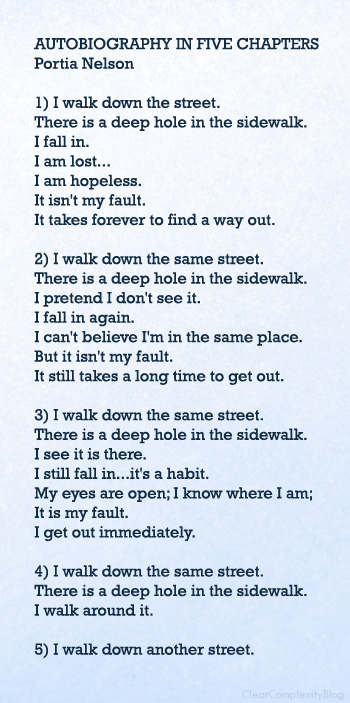
At some point during this time period I was given this poem:

I think the first time I was given it, I didn’t even read it. I was given this poem on several other occasions as a teenager. Eventually I read it but, seriously?, this person is stupid! Just don’t walk into the hole, right?

Later, as an adult, still struggling with many of the same issues that plagued me as a teenager, I was again given this poem.

Reading it, I understood that the person in the poem wasn’t actually walking into a hole in the sidewalk. It was a metaphor. And it made a lot of sense.

The title of the poem, “Autobiography in Five Chapters” is aptly named. I won’t dissect the poem because, like most poetry, each person interprets it in their own way. However, I will discuss the implications to change.

Change really centers on a few things. First, we must realize that there are things that we cannot change and that we have no control over. Next, we must be aware of our own actions and behaviors and acknowledge them as our own choices and responsibility. And last, we must desire and have the courage to make different choices.

It’s obviously an over simplified description of a life-long, complex process. As a teenager I viewed my life much as the second verse in the poem. I continually made the same choices and was surprised that I was in the same place. It simply wasn’t my fault.

With time and a lot of effort to be more aware of my choices and responsibility for those choices, I shifted into a viewpoint somewhere in between the third and fourth verses in the poem. I made the same choices and ended up in the same place, but I wasn’t surprised anymore and I knew how I had gotten there. Eventually I was able to avoid the choices I had made out of habit. And by doing so avoided the outcome.

At present, I’m very much present in the fifth verse of the poem. I’m making new and more aware choices. I realize that those choices are mine to make and, if I don’t like their outcomes, I am always free to make a different choice.

There are parts of life that are out of our control, that we cannot choose and we cannot change. But the majority of our lives and things come directly from choices that we ourselves make. We are in control of those choices and any change we wish to make for ourselves. So often we lose sight of all the choices we (unconsciously) make and all the choices we can make, by focusing too greatly on the few we cannot.

Someone once told me that there are always choices, and they were right. It’s your life. It’s your choice.

Moments

Moments.

That’s all we have. That’s all we ever had and will ever have.

Good moments. Bad moments. Moments that seems so insignificant at the time that later down the line we find ourselves replaying in our minds. Moments that make us feel something. Anything. That let us feel alive, if only in that very moment.

We’re all kidding ourselves to think otherwise. It truly isn’t about the grand picture, the sum of it all. It’s about the very little tiny times, scattered amongst the sea of monotony and sameness.

We don’t ever remember the majority of our lives. All the times spent sleeping or driving or working. We don’t keep those. We don’t keep the moments of repetition or status quo either.

And as quickly as we have them, as soon as we acknowledge their presence and grasp them with both hands, they slip away just as fast.

All we have is moments.

I know I keep writing about moments and being mindful, but  it’s because its important! And honestly, it’s easy to forget.

Building on yesterday’s post, The Myth of the Perfect Holiday, I want to continue to focus on slowing down and being mindful.

Mindfulness (or being present in the moment) is being aware without judgement — of life as it is, of yourself as you are and of other people as they are — in the present moment, here and now.

Whatever your attention is on, that’s what life is for you at any given moment. Focus on the negatives in your life and that’s what your life is for you. Focus on worries, that’s what your life is. Focus on gratitude and positives and, you guessed it, that’s what your life is for you.

deviantart: trancestor

Take just a few seconds to recall a moment you have really valued. Maybe it was a special time with a loved one. Or an experience you had in nature. Perhaps it was time spent with a child or a pet. Or a time you reached an accomplishment or supported a friend in need. Think about this time (write it down if you wish) and take the opportunity to focus on what really matters.

It’s so easy to get lost in life, swept up in the rush of emotions and movements. Take the time to be in the moment, whatever it might be, because it’s really all we have.

On Vulnerability

Sometimes I don’t write for long periods of time.

I have many thoughts on topics I could write about and ideas that are amazing and important points I’d like to make and a funny story about something that happened to me. I have many thoughts about how I could write these things down and expand on them and how amazing they are.

Most of the time I forget them. They never make it out of my maze of a mind.

Some of the time I write them down and realize what I thought was amazing, really wasn’t.

Some of the time I write them down and I realize that what I’ve written is amazing. That what I’ve been able to express in words truly conveys what I initially thought, honestly portrays how I feel and reveals pieces of utmost clarity and importance in my self-growth and realization.

And most often then, I get scared.

When you write something such as that it’s like finding an opening inside of yourself, like taking a light and shining it on parts of yourself that you weren’t fully aware existed. In examining those parts you identify them and name them. In a very real sense, you expose yourself because looking at anything that was formerly unknown requires some method of exposure.

For me, this sort of exposure, this vulnerability is one of my greatest fears. I commend those who put themselves out there, who allow themselves to be open without fear of outcomes. Without wondering what that vulnerability might bring.

Perhaps they have been fortunate to not have experienced the pain that can result from being vulnerable. Perhaps they have but have found ways to compensate for it. Perhaps they don’t calculate or view any risks.


I have been in many situations throughout my life where allowing myself to be vulnerable has been taken advantage of. Each time resulting in removing some of the vulnerability I allowed myself to give, until I reached a place where there was no room left for me to give any at all. Where I reached a place where the risks of doing so gravely outweighed any benefits of allowing myself to be vulnerable.

Those of us who have been through trauma, those of use who have been through abuse, those of us who have been manipulated, deceived, hurt… know that eventually we can’t allow ourselves to be vulnerable anymore. We build walls, physically, emotionally. We seclude ourselves from other people, from places, from experiences. We prevent the possibility of risk and further damage to ourselves.

I’ve spent a long time doing this. I’ve spent a long time avoiding people, avoiding experiences, avoiding anything more than the bare minimums of life. And, for a long time, doing so served it’s purpose.

Only in the past few years have I realized that my keeping everything/one a safe distance away was not only protecting myself from the risks but also preventing any of the benefits. Walls work both ways. They keep all of the painful, negative “stuff” out but they also keep all of the satisfying, positive “stuff” out too.

Dismantling walls (especially those that have stood for extended periods of time) is far from easy. You don’t suddenly go from being heaving guarded to being entirely exposed. Nor would it be a wise idea.

I’ve been working on allowing myself to be more vulnerable. Not recklessly so, but I’ve built such high walls that there have been parts of me that I wouldn’t even allow myself to be exposed to. It’s a frightening process and it’s terribly difficult not to regress backwards in reliving past events or using those past events as evidence against allowing vulnerability.

At this point I so clearly see that the only way I can progress in my journey of self-growth and self-acceptance is to continue to work on my issues of vulnerability. I can’t be angry at the lack of support and people in my life when I’ve honestly not offered any opening for such. Voluntary vulnerability is a manner of trust. In myself and in others.

So here I go, revealing an opening and shining a light on a part of myself I haven’t before. The walls continue to come down.

The “First” Thanksgiving

Every Thanksgiving Americans across the nation gather with family and friends. Huge, multiple course feasts are prepared, with all the fixings and favorites. Turkey. Mashed potatoes. Sweet potato pie. Cranberry sauce. Corn. Green bean casserole. Corn bread. And finishing with desert (if we have any room left in our stomachs!). We give thanks and rejoice at the bounty we have before us.

There’s traditions in each family around Thanksgiving. Special dishes of food. Perhaps viewing the Thanksgiving Day parade on TV. Or a football game. These traditions are special to each gathering, to each group of people. We take comfort and joy on this day as we reflect on what we are thankful and grateful for.

This aspect of Thanksgiving, of being mindful and aware of our gratitude, is one I support and enjoy. I have much to be thankful for. However, the myth of Thanksgiving is something I strongly disagree with and that I find upsetting. Especially as it’s taught in our public schools.

I wrote about my disdain on how Columbus Day is perceived and taught earlier this year. I am equally appalled by how Thanksgiving is presented, especially in schools.

My oldest daughter, Z,  is in 2nd grade and for the last three years I have needed to “re-teach” her about Thanksgiving. This year she told me her teacher had read the class a book about the Pilgrims coming to America and how the Indians helped them. She told me about “the first Thanksgiving” where the Pilgrims and the Indians sat down and shared dinner on that day. In 1st grade she shared a similar story with me that she had learned in school. And in Kindergarten, she brought home a photocopied book she had made, the first few pages are shown below.

Looks real peaceful. Smiling Pilgrims with a gun and a solemn Native American.


So… what’s so wrong with any of this? Why am I upset over it? Honestly, I’m upset and saddened because what I was taught in school as a child, and what is apparently still being taught to my daughter, isn’t true. When I mentioned to Z this year that what her teacher read the class was a nice story, she defended the story of the first Thanksgiving by telling me that it really happened.

It didn’t. The story of the first Thanksgiving that we have been told is a myth. A legend.  The idea of Pilgrims and “Indians” sharing a peaceful meal is entirely fabricated.  There were many days of thanksgiving, both amongst the Pilgrims and in Native American tradition and these were celebrations of a successful harvest season. Much more of the myth is, well, myth, right down to what the Pilgrims and Native Americans wore or ate.

There’s also many omitted details. Such as  in 1637, when the day of Thanksgiving was a celebration of the return of Pilgrim men who had traveled to Mystic, Connecticut and fought against the Pequot tribe resulting in the deaths of 700+ Pequot people. Or of Pilgrims robbing the graves of  the Wampanoag tribe and stealing their food (information that comes from a Pilgrim’s account of the first year). Rather than these events being altered, they are entirely left out.

My dismay over the Thanksgiving story as it is currently presented isn’t solely based on the omissions on how Native Americans were treated. Or the stereotyped construction of Native Americans being primitive and dumb. It isn’t from the way Pilgrims are presented either, as pure models on which to base our selves. My dismay is that we are teaching our children (and adults) that this story is truth. That the story that has been constructed as the first Thanksgiving is history.

Why do we teach false history? If the idea of the thanksgiving tradition is important somehow, then why don’t we frame it as a tradition? Why don’t we frame it as a story? When we frame it as, “this happened” we aren’t teaching our children anything worthwhile. James W. Loewen wrote in his novel Lies My Teacher Told Me that, “The antidote to feel-good history is not feel-bad history but honest and inclusive history. If textbook authors feel compelled to give moral instruction… they could accomplish this by allowing students to learn both the ‘good’ and the ‘bad’ sides of the Pilgrim tale. Conflict would then become part of the story, and students might discover the knowledge they gain has implications for their lives today.” (p 97)

Those who fail to learn from history are doomed to repeat it

History should allow us to learn from it. It’s my hope to raise two confident, intelligent children with the capacity to critically think and examine what is presented to them. And to be able to decide what is truthful based on their own exploration of such, not blindly believing what they are taught or told. It isn’t only the past history of our nation that we are misinformed on. The events that are currently happening in our nation are often misconstrued, censored and even hidden — by the media, by those in power and by the overwhelming fact that most of us aren’t even aware. Try googling ‘UC Davis Pepper Spray’ or ‘Occupy Wall Street’ and see how aware you are of the events happening right now, in our nation.

This Thanksgiving, I am thankful for the teachers and people in my life who taught me to critically think, to question, to examine and seek out the truth in everything.

Coping with Holiday Grief

Holidays can be a difficult time.

There’s the stress of  planning, of cooking a meal, of traveling to destinations. There’s the stress of family. Of gathering everyone together. Of  relationships that may be less than ideal. And the feeling of absence of loved ones, either through distance or death.

It’s now been over a year since my father has passed away. This past Halloween was the second year without him and tomorrow will be the second Thanksgiving. People have told me that it will, “get easier” but so far that hasn’t been my experience. I find each holiday, each event and milestone to be equally as difficult as the last.

There’s a constant feeling of, “he should be here.” This past June as I sat at my graduation, waiting to walk for my Early Childhood degree, I had difficulty containing my tears and my emotions. I kept trying to focus on the speakers, on those sitting around me, on the number of seats in the venue… on anything to distract myself from the running thought in my head that he should be here.  Because he should have been there. While I was proud of my accomplishments, my feelings of loss were overwhelming.

My feelings of loss exist outside of holidays and milestones. Perhaps this is just another stage of grief. Or perhaps this is a lasting feeling. I mean, I miss my dad and it follows logic that I would feel that loss even more so in times of heightened significance. Holidays. Birthdays. Graduations.

People that play such a vital, important role in our lives surely would be missed. Surely their absence wouldn’t be overlooked.  I don’t want to dwell on the sadness of his absence. I don’t want to allow my feelings of sadness to become a surrogate replacement for the place where, “he should be”. So how can I, and others dealing with loss, handle the upcoming holidays (and other milestones) ?

Griefnet.org offers several articles on dealing with grief during the holidays. Below are a few points I found to be particularly helpful:

  • Holidays often magnify feelings of loss of a loved one. It is important and natural to experience the sadness that comes. To block such feelings is unhealthy. Keep the positive memory of the loved one alive.
  • Often after the first year the people in your life may expect you to be over it. We are never over it but the experience of many bereaved is that eventually they enjoy the holidays again.
  • Don’t forget, anticipation of any holiday is so much worse than the actual holiday.

Keeping the positive memory of a loved one alive, by celebrating and remembering them can help to cope with the grief of loss. Here are a few ideas on how to do so:

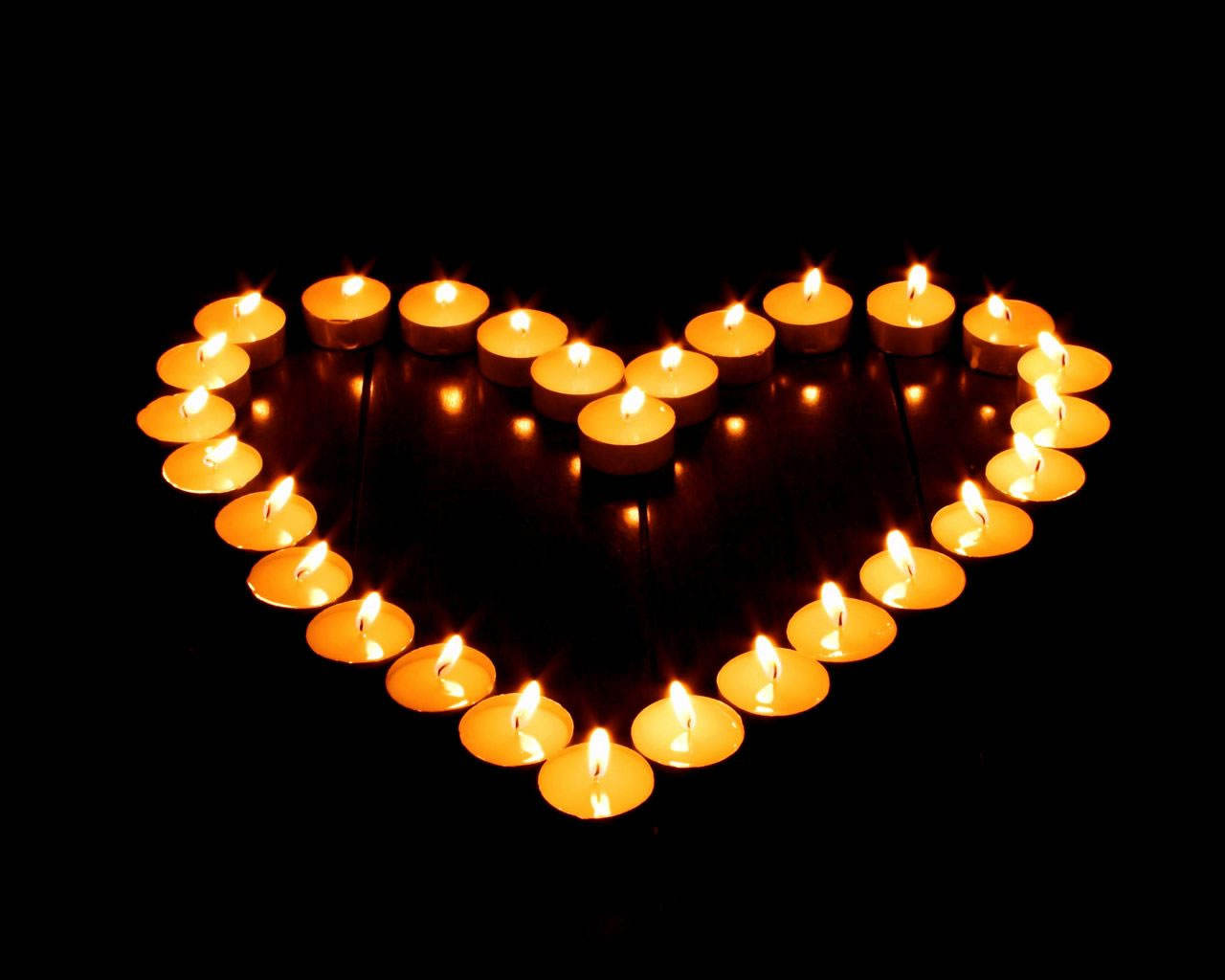
  • Light a candle to honor your loved one, perhaps during holiday gatherings as a reminder of them.
  • Create a memory box by asking family members and friends to write down a good memory they have of your loved one. These may be shared as a group or viewed at a later point privately.
  • Look at pictures and/or videos of your loved one. Often times these will spark memories and encourage conversation of good times.
  • At a gathering, encourage family and friends to make colleges of words and images that remind them of your loved one from old magazines, scissors and glue.

Overall, be gentle with yourself. There is no magic amount of time designated for grieving. There’s also no “right” way you should be feeling. Do what feels comfortable to you and allow yourself to feel however it is you feel.

Focus on Success

Some days are filled with frustration. With waiting. With anger. With lack of movement. With lack of change.

Some days, despite our best efforts, we don’t receive the things we need and require. We don’t accomplish the goals we set out to reach.

And we don’t hear the words we need to hear.

On some days, this is due to our own inability to hear them. Those around us are speaking words of praise, acknowledging our accomplishments and our successes. Providing support and encouragement in continuing to succeed and offering constructive criticism in an effort to encourage our growth in those areas. On some days, we are lost in our own minds, our focus elsewhere, and we do not hear all the positive feedback that we receive.

On other days, there is no one speaking words of praise. On these days we must speak praise to ourselves. We must acknowledge our own accomplishments and successes, encouraging ourselves to continue moving forward in our goals. On these days we must be patient with ourselves and realize that despite the lack of outside support and encouragement, we are doing a “good job.” We are doing the best we can and we will continue to do better. We must be kind to ourselves and speak positively of our accomplishments, noticing our strengths and weaknesses while weighing them equally.

At times I become frustrated as I continue to look for praise & approval from those who have never given me such. From those who continually choose to overlook my strengths and instead focus on my weaknesses.  I am not perfect. Neither are you or anyone else. We all have our own strengths and our own weaknesses. To focus solely on either, in ourselves and others, is neither kind or productive.

We must try to focus on the strengths in ourselves and others.  Constantly receiving negative feedback (about our weaknesses, our failures, our mistakes) while neglecting any positive feedback (about our successes, our accomplishments) doesn’t make us feel good — whether the talk is coming from another person or ourselves. A focus primarily on negatives (even if the goal is improvement) brings our thoughts to “I-can’t-do-it” and provides supporting examples of such beliefs.

Identifying and acknowledging strengths provides a foundation on which we can build on. A focus primarily on strengths provides examples of times we have been successful, allows us to examine how we were able to succeed and empowers us by identifying methods that have previously resulted in success.

I know when I’m told that I’m, “doing a good job” I tend to not believe such. What does “doing a good job” mean? How is it defined? Statements like that are generic and don’t provide any supporting “evidence” that I, or anyone else, really did a good job. In acknowledging success we must be specific. For example, “You did a good job at setting the table. You really paid close attention to where the forks needed to be placed.” Not only did I offer praise but I gave focus to a specific aspect of success and used “you” statements to show objectiveness, rather than “I feel…” or “I think…” statements, which show my subjective view.

We could all benefit from an increased focus on strengths. While there is a space and time for constructive criticism, we as people also need to hear what we are doing well. We need to hear praise and acknowledgement of our accomplishments. We need to hear support and encouragement. We need to hear these things from ourselves but we also need to hear them from those around us.

Can we try to not only focus on the positives, but also communicate them – to others and to ourselves? I truly believe that we are all doing the best we can in this moment, given the knowledge, resources and support we currently have. Let’s tell those around us that we see the accomplishments they’re making and the things they are doing well. Let’s help them build their foundation for continued success and build upon our own in the process.

#ThingsAYoungMomDoesntWantToHear

Across the country (and even over seas!) young mothers are uniting in a discussion on a common topic – their experiences as a young parent. The hash tag #ThingsAYoungMomDoesntWantToHear was started by blogger and former teen mom, Natasha Vianna about her frustration with comments made to young mothers. You can read more about how and why #ThingsAYoungMomDoesntWantToHear started in Natasha’s blog post at the PushBack.

Clearly Natasha struck a chord with other current and former young moms, who have utilized the hash tag and shared their own frustrations and experiences. As a former young mom, I too joined in on the discussion. I was 19 years old when my first daughter was born and by 23 I had two daughters. The stares I received and the comments people have felt the need to share with me have, at times, been appalling.

Shortly after leaving my abusive, dead-beat boyfriend I was at my postpartum check up. My beautiful 6-week old daughter was sleeping in her car seat, as I sat in the waiting room filling out papers.  Two middle-age ladies who were sitting near by “whispered” to one other about how I was, “Just another one of those girls.”  It sadly wasn’t the first nor the last negative comment I have heard.

You’re doing a good job… for a young parent (& why is that surprising?)

Why didn’t you marry your [abusive] baby’s father?

Your life held such potential [it still does]

Really? You have two kids?

Its irresponsible of you to want your own identity and interests

 How unfair that teens are having babies when there are couples who are unable to conceive [no correlation]

I was fortunate to connect with a young mom group in my area at that time called MELD. Once a week several other young moms, myself and our children would meet. For the first hour we shared dinner with one another and our children. Afterwards our kids would be watched by volunteers and the remaining time would be split between sharing and education. As we shared our experiences with one another, there seemed to be an endless supply of rude, appalling things we were being told.  Though I have graduated from the group, I still keep in contact with most of the moms. I have also made amazing, supportive friendships with many young parents online.

Despite assumptions and stereotypes placed on young mothers, we are succeeding. I’ve completed a college degree and am working on a second one to become a social worker (working with young parents and their children). I’m a member of my school’s honor society and my GPA is a 3.549. My young mom friends have also graduated high school and gone to college.

As Katie of A Girl Like Me blogs: “We’re not all on welfare, and we’re not all party animals or sluts or druggies like the girls who give the rest of us a bad name. We love and take care of our kids just as much as ‘normal’ aged mothers do. We’re still intelligent and productive members of society. We grow up with our kids, and I feel like we learn more life lessons that way. The young moms I know are some of the wisest people in my life.”

Natasha Vianna blogs that, “Hearing the success stories of young moms can sometimes anger people even more. If we’re not falling into the ‘stereotype’ and have made something of our lives, we are told we are still a bad example! We are told we are promoting the concept of becoming a teen mom. When we fail, we get the ‘I told you so!”

The stereotyping and judgments placed on young parents is appalling and damaging to their success and the success of their children. General assumptions, such as the ones shared on #ThingsAYoungMomDoesntWantToHear can be truly damaging. We are empowered by speaking out and sharing our experiences as young moms. I encourage all young moms, current and former, to join in the  conversation on twitter #ThingsAYoungMomDoesntWantToHear