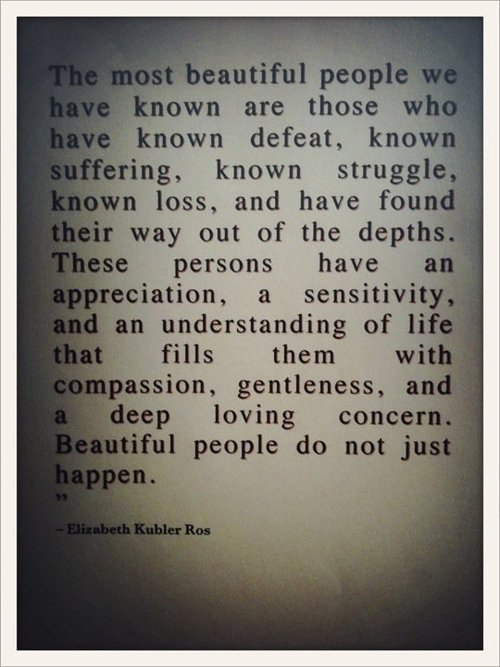
Beautiful People
Leave a reply
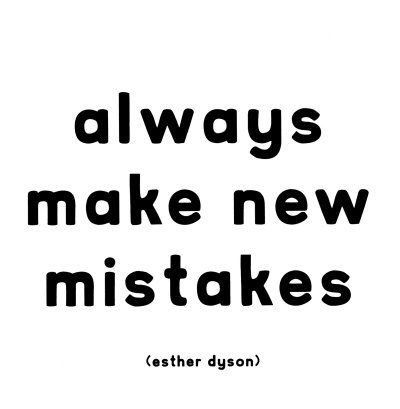
Yesterday morning I was already running late. Wednesdays are my busiest, craziest day of the week and I somehow always manage to fall behind. I went upstairs to wake my daughters, only to find E, my 3 year old, standing in the bathroom with an exploded pull-up. An exploded poopy pull-up. Now, if you haven’t ever had to deal with this (and I truly hope you’ve been spared!) let me tell you, it’s…disgusting. Not only did the pull-up explode but there was poop all over her pajamas, her legs and the floor. E needed a shower (which is what you get when you live in a house with no bathtub, but that’s a different story). I got Z, my 7 year old, downstairs to get dressed and ready (not an easy solo task for an easily distracted little girl) and went back upstairs to give E a shower. Of course, E didn’t want to take a shower. After much pressuring, she got in the shower and, 20 minutes later than expected, we all made it (somewhat) ready to the dining room table.
At this point we weren’t just a little late anymore, we were really late. And I still needed to feed them breakfast, put dinner in the crockpot and finish getting ready. I gave them breakfast and started on dinner. When I looked back a moment later, the girls were fooling around and not even at the table. I’m not going to sugar coat it. At this point my patience snapped and I raised my voice to tell them to, “sit at the table, be quiet and eat your breakfast.” One of them started to say something and I cut her off saying, “if it isn’t an emergency, I cannot hear it now.” They sat. They were quiet. And they ate their breakfast. But I felt like shit over how I had handled it.
As I began putting the chicken in the crockpot, piling ingredients on top, I took the moment to slow down and really process what had just happened. Was it worth damaging my relationship with my children to avoid being late? We were going to be late either way. Did it really matter (why I was upset)? Or could I let it go?
I thought it over and, quickly, decided that my relationship with them was of #1 importance. I sat down at the table with my daughters and apologized for raising my voice and being snappy. In doing so I owned up to my mistakes and modeled an appropriate method of resolving them. I asked them if we could all start the morning over, because I didn’t like how I acted and how it went (again, taking responsibility). Unprompted, they both apologized for not listening to instructions and said they would also like to start over and try again.
I work very hard not to raise my voice with my children, as I realize what they must feel when I do so. I don’t like it when someone raises their voice to me. It makes me feel horrible. And small. On the occasion that I slip up and do raise my voice (and, who are we kidding here, it does occasionally happen as stressed out parents) I like to use the Slow Down, Start Over model. It acts as a reset button. And you can use it anytime you wish.
Slow Down, Start Over
The process of doing this shows kids how to take responsibility for their actions, that mistakes are ok (AND that moms make them too!), to apologize/make ammends, and to let it go so you can try again. It frames mistakes as a method of learning and growth. It can be parent or child initiated. And, many times, it works. After our morning start over the remainder of yesterday went quite well. Yes, we were late, but my children were able to see me as human (instead of the supermom I try to be) and we were able to use it as an opportunity to learn.
I’m (still) working on staying in a positive place. In a positive state of mind. In a positive perspective.
I cannot change the world around me. I cannot change the way other people choose to act. Or not act. I cannot change who my family is. Or which of them are alive to be here with me. I cannot change what people think or say about me. I cannot change how the driver on the road in front of me drives. I cannot change the teachers my daughter or I have. I cannot change the weather. I cannot change where I live. I cannot change the bills I have to pay or the things that need to be bought. I cannot change the work I have to do. I cannot change the chores that need to be done. I cannot change the way my kids react to situations. I cannot change the choices of others.
I can change how I deal with it. And how I view it. And how I react. I can change what I do. Nothing more.
“Life is not a matter of having good cards, but of playing a poor hand well” – Robert L Steve
I’m working consciously every day to do this. My world isn’t going to change any other way. And in doing so I am starting to see things as looking up.Last week the home daycare my girls go to needed to close for the day last minute, due to the death of a family friend. In the past I might have gotten worked up and anxious about it, jumping ahead to all the what-if’s without even allowing myself to process. Instead, I looked at my calender, saw I didn’t have anything I had to do sans children and simply told the provider that I was sorry for her loss. No panic. No worry. That day I kept E, my 3 year old daughter, home with me and we watched a movie and painted our nails. Later she helped me make bagels into pizza for lunch and chili for dinner. Nothing had changed except how I chose to look at the situation.
On Saturdays the girls take swimming lessons at the Y, with a 1/2 hour break in between the timing of their lessons. It’s usually a struggle and quite stressful. But last week I brought coloring books, workbooks and colored pencils. Z, my 7 year old daughter, and I walked down the street to get some coffee/steamed milk for everyone while B, my partner of almost 7 years, stayed at the Y with E while she swam. It was the last class of the session and E did so well in the Pike level of swimming that she was been moved up to the next level (Eel) for the next session! This will work out much better for us because now their lessons will be one after another, instead of a 1/2 hour break in between. Instead of what could have been a stressful morning, I was able to feel more relaxed due to planning and going into the situation positively.
I’ve been thinking more about what I need and want. It still feels really selfish most of the time but I need to take care of me in order to begin feeling like I’m moving in some direction (hopefully toward happiness!). Currently I’m in the Human Services Social Work transfer program at my community college. I’ve already completed an AA in Early Childhood Education. I want to transfer after graduating to earn my BS but hadn’t really looked too deeply into it. Mostly out of fear. This week I met with the transfer counselor to find out when Elms College (where I’d like to transfer to) is sending a rep to the community college so I can meet with them. I’ve also been looking into financial aid and scholarships, since Elms is expensive. I was looking through the Elms website and noticed that Elms College offers merit-based scholarships to transfer students, noticeably the Elms Phi Theta Kappa Scholarship that is offered to students that have been inducted into the Phi Theta Kappa Honor Society (the scholarship is pretty hefty at $8-10k a year!).
In further researching Phi Theta Kappa I learned you need a 3.6 GPA to be invited to join. So I am now working to get my GPA up to a 3.6 (from a 3.549) so I can get admitted to Phi Theta Kappa. This means I need a 4.0 from here out at the community college, though if I retake a class I previously had earned a C grade in and received a B+ or A, that would significantly help my GPA. I likely will retake that class since it’s a 100 level class and I took it in 2002 when I honestly (and unfortunately) didn’t care much about my education.
I’ve been attending a weekly DBT class since the beginning of 2011. It’s structured in modules, each covering two topics and lasting 11-12 weeks. I’ve found the class itself and the skills taught to be quite helpful and very likely helping in my growth. I was upset that I had to drop out of the last module due to time constraints but I’m really glad I could take this current module. I hope to begin sharing some of the skills I have learned in DBT here.
All in all, I feel better. It’s not perfect. I still cry when certain songs come on the radio. Or when I’m watching sappy kids movies with the girls. Or when I think of my dad (who passed away in November of 2010). I don’t know that those things will ever change though. But I’m choosing to look at them differently. It is what it is and nothing more. Making it anything more than me crying at a song (etc) just makes that feeling bigger than it truly is and allows me to get stuck in it. I don’t want to get stuck feeling like that. Instead I will try to ride it like a wave, to just let it come and wash over me, to experience it, to acknowledge it. And then to let it go.
Currently I’m dealing with a person that really gets my goat. I’m sure you know the type (though it’s different for everyone)… they seem to push all the buttons to annoy, frustrate and anger you. They may have habits or traits that are opposed to your own. They don’t take kindly to suggestions or advice…in fact, why would they? This is the type of person who knows everything regardless of the topic, regardless of the context, regardless of their education or anyone else’s in the subject being discussed. It’s their way or… well, it’s really just their way.
If you haven’t had the opportunity in your life to cross paths with an individual like this, never fear because it’s an almost certainty that at some point you will. And when you do, you too will be faced with the dilemma on how to deal with them. Most importantly how you can deal with them, while retaining your own self worth and respect and staying within the bounds of your beliefs and morals.
First, if it’s a situation where you do not have to directly deal with this person (for example on the train or at a party), then DON’T. If this is someone you have no obligation to at all, kindly excuse yourself from the situation. It’s not worth your time, energy or stress level to deal with someone of this manner when you don’t need to. Trust me.
Second, if it turns out this person IS someone you need to deal with and do not have the option of excusing yourself from (such as a co-worker or a family member) then you’re going to need to find a way to do so without detriment to yourself. Chances are this person may not realize (or potentially care) how much distress they are causing you (and possibly others). If you are close to them or feel a particular responsibly to them, you may feel the need to figure out the underlying cause of their behaviors. It might be that they are dealing with some personal issues (such as mental health or substance abuse). However, even if this is the case, you shouldn’t martyr yourself to “save” someone who may not actually want to be saved. You cannot change or help anyone who does not have the desire to change or be helped.
In dealing with people that push your buttons it’s best to have as limited interactions as possible. When needed, know your limitations and the level of distress you can handle and kindly excuse yourself temporarily from any situations before they reach a boiling point. It’s much easier to excuse yourself to use the bathroom (or the like) to cool yourself down that to have to explain why you’ve verbally or physically assaulted another human being. Remember, we’re trying to keep our own morals intact here.
If you are in a situation with a button pusher where excusing yourself is not possible (in a car, etc) then these strategies can prove helpful. Distract yourself with something else. Rather than focusing on the person that is causing you distress, focus on something (anything!) else. One method is to look around the room and find items (visually) in a certain color. Another method could be writing or making lists. Deep breathing is a great way to distract yourself and calm yourself down. Take a deep breath through your nose and think to yourself “1”. Next exhale your breath through your mouth and think “2”. Continue this method as you feel necessary.
Despite these methods you still may feel your buttons being pushed. Remember that the only things we can change are ourselves and our actions. We cannot change anyone else. Getting fixated on a person who angers, annoys or stresses us will not change that. Any belief to the contrary is false. At the end of the day we are all free to do whatever we want to do.
Note: This post was constructed for an assignment in an Honors Contemporary Social Problems class I took in the Spring of 2011. I rather liked the work I produced for this class, so I will continue to leave this post up despite the (potential) disconnect from the current focus of my blog. This post was a part of the final project for the class (along with an oral/visual presentation) and included researching and examining all aspects of claims-making on a topic of choice (income inequality).
__________________________________________________________________________________________________________________________________________
Timothy Noah, who authored a series looking at income inequality on Slate states, “It’s generally understood that we live in a time of growing income inequality…” (Slate) A large portion of claims-makers on the topic of income inequality view it in the same belief: that income inequality is rising in the United States.
Another major claim that was frequently seen is the belief that there is a correlation between income inequality and social issues. The construction of this in claims ranges from implied to near fear-inducing.
This claim leads into another claim, “the gulf between the wealth of America’s richest and poorest is widening, and few signs show any indication of it slowing.” (Huffington Post)
The rich are too rich. This is illustrated with the use of graphs, charts and the data most used in claims on income inequality: “the richest 1 percent of Americans hold about __ percent of U.S. income/wealth.” I will go into deeper detail on this later in my post.
One sub-claim that consistently appears is that Americans believe in social mobility and that this believe is imagined and does not match real social mobility. Along the same line, there are claims of Americans having, “[a]n incorrect assessment of one’s own standing in the income distribution…” or that all, “[a]mericans all seem to think they’re ‘middle class.’” (Economix Blog, New York Times)
Not all economists agree income inequality is a bad thing.
Claims-makers of income inequality are varied and include the following:
Media
Government
Academic
Activists
Economists
The majority of claims-makers that I looked at did not explicitly define income inequality. Defined loosely, income inequality is the unequal distribution of income. In order to better understand income inequality, income itself needs to be defined.
Most of the data I looked at defined income vaguely as “market income.” Non-Profit Quarterly stated, “The data purposefully includes only market-generated income (wages, pensions, business income and interest), excluding government transfer payments.” (Non-Profit Quarterly) Government transfer payments, are those from social service agencies such as welfare payments and social security.
It is important to make note that income is not the same as wealth. “Income is what people earn from work, but also from dividends, interest, and any rents or royalties that are paid to them on properties they own.” Whereas, “…wealth is the value of everything a person or family owns, minus any debts.” (Wealth, Income, and Power,by G. William Domhoff) In this way, a person’s income and wealth are too very different things. In looking at claims on income inequality, many claims-makers do not distinguish the differences between income and wealth, and thus income inequality and wealth inequality. Claims-makers take income and wealth to be interchangeable, which objectively they are not.
For example, the first sentence of an article from PBS Newshour states, “Income inequality has changed over time: today the richest 1 percent of Americans hold about 24 percent of U.S. wealth.” (PBS) The article continues stating, “But almost a century ago in 1915, that same top percent had 18 percent of the nation’s wealth, according to Berkeley economist Emmanuel Saez in his report ‘Striking it Richer.’” The report by Emmanuel Saez clearly states income data in the US, not wealth.
And yet the statistics from this report are consistently used in many claims-makers claims about income inequality incorrectly.
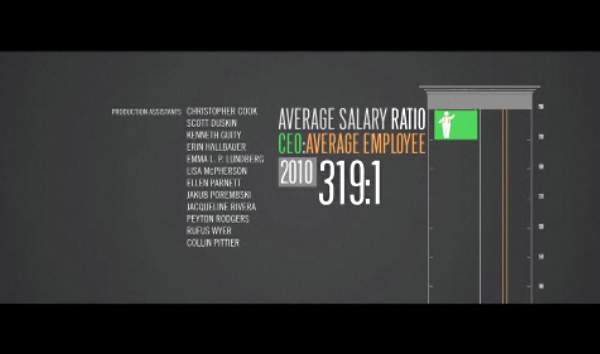
Picture Mill, End Credits “The Other Guys”
Timing plays a HUGE role on the claims being made. Some of the relevant issues are the president’s proposed tax rates, current debates regarding the national debt and decisions being made on investing or defunding the safety net for people or places (cutting services and funding). Claims about income inequality are also a way to frame the economy, unemployment, the recession, corporate crime and government bailouts. The claims very much piggyback on these already widespread issues.
The claim of inequality in relation to the economy and money is already a mainstream idea. It was referenced in the end credits of the Will Ferrell and Mark Whalberg comedy “The Other Guys” with an animated sequence explaining Ponzi schemes, TARP bailout, and imbalance of CEO pay. A buddy-cop, light-hearted comedy one wouldn’t expect to find such serious, political information in the end credits. What’s more interesting to me is that, “‘[t]he sources were official government documents,’ [says] art director Grant Nellessen. ‘Sony had to vet everything to confirm we weren’t making up facts,’ he says. ‘It wasn’t just our opinion.’” (MovieFone)
Claims-makers make use of typifying stories that focus on victims. Victims are mainly the middle-class and poor, though occasionally the upper class (such as in this Fortune article)
“Many feel the middle class is disintegrating, as are their prospects. Cookie Sheers, for example, who works at a non-profit:
‘There are days that I walk to work because I couldn’t afford $1.25 to get on the bus,’ said Sheers, a single mother of three who makes $34,000 a year. ‘There are days that I sacrifice a meal because I want to make sure my children eat.'” (PBS)
As you can see in this story from PBS, the claims-makers are constructing a victim that is very sympathetic. She’s a single mom, who sacrifices for her kids and going without meals so her children can eat. And she works for a non-profit, which helps construct her as a moral person and adds to the construction of victim purity.
“…a woman named Colleen, a single mother of two, saying much the same thing about the wealthy families whose floors she scrubs on hands and knees. ‘I don’t mind, really,’ she says, ‘because I guess I’m a simple person, and I don’t want what they have. I mean, it’s nothing to me.'” (Slate)
In this story from Slate we are again presented with a sympathetic victim. Another single mom, who is scrubbing floors for the wealth. And not just scrubbing the floors, she’s on her hands and knees scrubbing the floors. But despite the hardships that have been constructed on her, she’s modest and portrayed as being content with what is constructed as a difficult life.
Villains in this claim are usually not clearly defined. If a villain is defined, it is framed as being the social problem itself.
The social problem of income inequality is constructed in the diagnostic frame as social, as it is a societal issue that requires a societal change. Motivational frames in the construction include capitalism and the family.
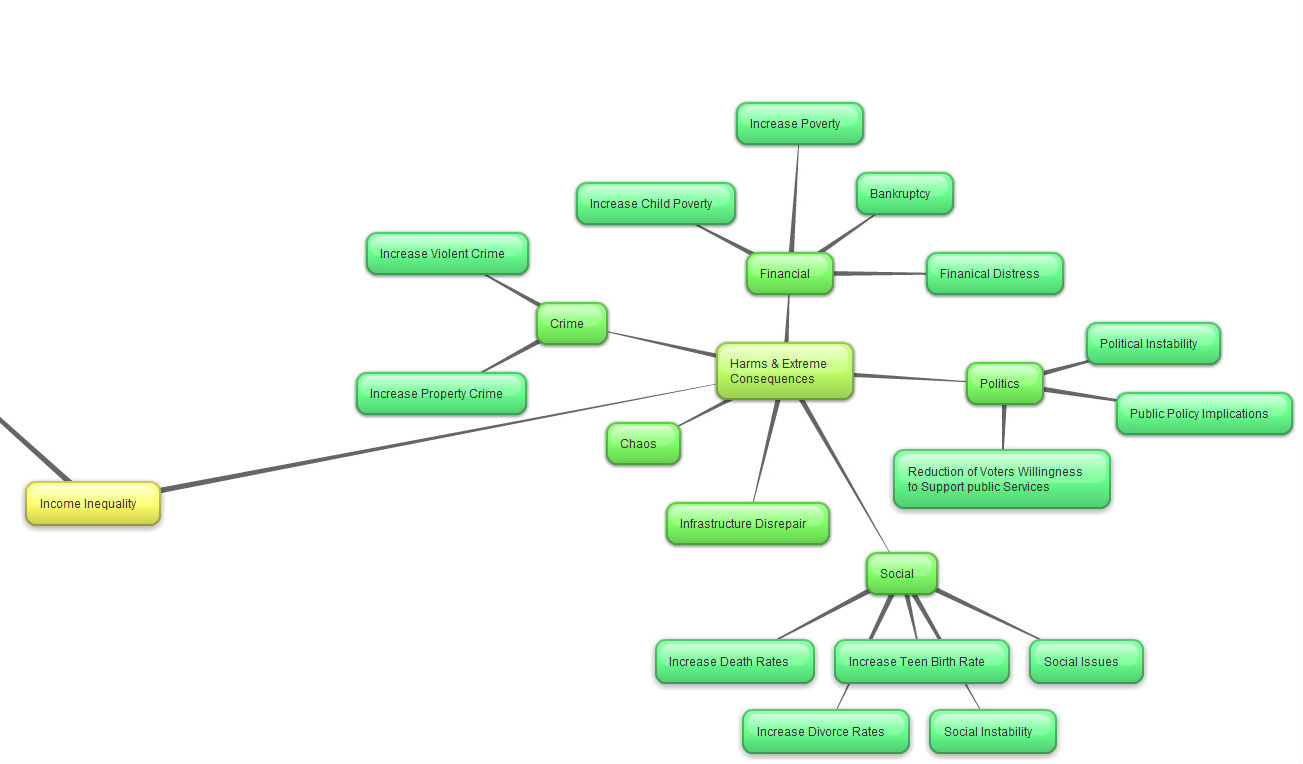
Income inequality claims include everything from crime to financial problems to political instability to increasing social issues to the disrepair of roads…all the way to CHAOS! Many are not specified but are definitely intended to provoke fear. The Yonder has an article that claims, “Our brief analysis documents how income inequality has some relationship with crime rates (both violent and property), teenage birth rates, and poverty rates (overall and child poverty). ” They illustrate this with brightly colored charts, each showing that as income inequality increases so does crime, teenage birth rates and poverty.
Claims-makers use graphs, charts and statistics to help construct their claims.
One thing that confused me was that there were different figures used by claims-makers stating 1% of Americans have 18%, 23.5% or 24% of all income.
“The share of total income going to the top 1 percent of earners, which stood at 8.9 percent in 1976, rose to 23.5 percent by 2007” (NY Times)
“Today, the richest 1 percent account for 24 percent of the nation’s income.” (Slate)
The data comes from a report by Emmanuel Saez. Upon researching it I found that the statistic of “Top 1% of US earned 18% of all income” is from data in 1915. The statistic of “24% of all income” is a rounded up number from the correct data of “23.5% of all income” which was computed using IRS data from 2007 and that was published/analyzed in 2009. It is the most recent data available. This statistic was also skewed at times, interchanging income and wealth to mean the same thing (they are not). This PBS article incorrectly states, “Income inequality has changed over time: today the richest 1 percent of Americans hold about 24 percent of U.S. wealth,” substituting wealth where income should be. (PBS) Other claims also made this mistake. Despite income and wealth being two different things they are often times used interchangeably by claims-makers.
Graphs are also widely used. The Daily Yonder, a site for rural Americans, posted an article on income inequality using counties. They also correlated income inequality to a host of social issues and crated graphs for each one. I find the choice in graph coloring makes it somewhat difficult to read. It also seems much of the data they used was from estimates or surveys. (Daily Yonder)
Another site that was encompassed almost entirely of graphs and charts was this post from Mother Jones, entitled “It’s the Inequality Stupid: Eleven charts that explain everything that’s wrong with America.” An important thing to note is that only the first chart is about income inequality. (Mother Jones) Labels need to be clearly read, as well as one having the ability to properly read charts and graphs in order to obtain accurate information. In this way, claims-makers can often confuse or misinform people who aren’t paying close attention to the information provided or ignore charts and graphs all together, leaving gaps in the bigger picture.
Interestingly, while most claims agree that something should be done, many don’t give any solutions:
“…we should just agree that it’s a bad thing — and try to do something about it.” (New York Times)
“What is the ideal distribution of income in society? I couldn’t tell you, and historically much mischief has been accomplished by addressing this question too precisely. But I can tell you this: We’ve been headed in the wrong direction for far too long.” (Slate)
“We would suggest that policy makers also consider the continuing increase in income inequality in this country” (Daily Yonder)
The ones that do offer a prognostic frame, focus mainly on changes in taxes or the need for more education and higher skilled workers. “So if you look at it, there are, basically, a few ways to change the distribution of inequality of wealth, taxes is one of them.” (NPR)
Fortune offers this:
“Worker education is the key. It will make them more productive — and richer…Workers’ skills aren’t keeping up with the advance of technology, so the shrinking proportion of workers with the needed skills command a larger share of the pie. Get high school and college graduation rates rising again, and the economic forces reverse, spreading the benefits of economic growth more evenly.” (Fortune)
While more education sounds like a good idea, since higher education levels should ideally equal higher incomes, it isn’t necessarily the case. The US already has issues with unemployment and recent college graduates being unable to find jobs is their fields. Additionally, a college education isn’t free. The cost to benefit ratio of paying for a higher education needs to be looked at, as well as career outcomes and employment opportunities in those fields.
Income Inequality Slide Show : Power Point Presentation
I often find it impossibly difficult to focus. I may have ADD to compound the matter, but I know I’m not alone in my inability to pay attention and stay on task. I’m frequently found making dinner while emptying the dishwasher, corralling children, helping with homework, letting the dog out and conveying directions to my partner on the phone.
Multi-tasking has become more than just a way that people do things; it has become the norm, for myself as well as a good portion of society. And it has it’s purpose. And it’s place.
But multi-tasking constantly doesn’t help anyone’s difficulty to focus, especially not mine. How can we expect to focus when we’re trying to accomplish multiple tasks simultaneously? The two are diametrically opposed in principle.
Sometimes we need to have the ability to get a vast array of things completed in a short amount of time. Multi-tasking works well for this. But what about when we really need to focus on one particular task, a task that requires detailed attention? Something like a report or a physical task, such as painting trim in a room.
Recently I’ve begun learning about mindfulness. Mindfulness is a main component in Buddhist meditation, as well as Dialectical Behavioral Therapy (DBT) and many other practices. Generally, it’s about being aware in the moment. One exercise in mindfulness that I have been practicing is picking a task and practicing staying present in doing that task.
For example, if I choose the task of eating I would try to pay attention to eating and only eating. I would really be aware of picking up the food with my utensil, of putting it in my mouth, of chewing it and swallowing it. I would notice the smell of the food and the taste, as well as consistencies and temperatures. I would be fully mindful in the moment of what I was eating.
It’s truly surprising if you pause to think about how many other things most of use do while eating. We hold conversations. We watch television. We read books. We surf the internet. We talk on the phone. We text. We drive. I’ve been practicing this exercise for a few weeks now and it’s amazing the difference in my experience eating when I am successful in being mindful. I actually taste my food. And I eat better quality food and less of it.
By practicing mindfulness in this manner, I am better able to access the focus I gain when doing other tasks that require singular attention. Writing reports has become a bit easier in that I can better bring myself back to the task when I am distracted. I can better stay on the task, and just the task, as well.
It’s by no means perfect, as nothing is perfect, but it is an improvement. I will continue to practice in hopes that I can further improve my focusing abilities. Don’t let the name scare you off, mindfulness is something we’ve all done at one time or anything. Putting a label on it doesn’t change what it is – and that is really being present in the moment. It’s seamlessly easy when we’re having a “good” time. But with practice we can all gain better control of our abilities to focus on tasks that would likely not fall into the “good” category. And that’s all it really comes down to. No one is in control of our lives but ourselves.
I don’t think people wake up one morning and decide not to have any motivation, any goals. I don’t think anyone one day thinks to themselves, ‘Self, you know what? I’m just not going to try anymore. I’m just going to give up.’
Honestly, giving up is a last ditch option. Yes, you know that person who just never really did anything. But, really? Did they really not ever do anything? Or did there life never present them with that option? With the choice to do something, anything?
I think if we really look at people, more often than not, people merely get stuck in their lack of options rather than actively choosing not to do anything. A child who grows up in a family with parents whose primary concern is obtaining and using drugs never had the experience of anything different. That’s not an easy thing to just cast off once they’re 18 and on their own. The child who grows up in foster care, being bounced from one house to the next, where they are primarily a “paycheck” and a burden, doesn’t suddenly have the experience of feeling secure once they turn 18.
And yet that’s what ‘society’ (and I use that term oh so loosely) expects. That all these people in our world who are homeless or jobless or lacking of a variety of experiences… well, they just don’t want it enough. Or they aren’t trying. But that’s like expecting someone who has never flown a plane or driven a car to just get in one and know how to drive it. And when they don’t telling them, ‘You just don’t want it enough,” or “You aren’t trying.”
People cannot possibly know how to do something they have never done before. Have never even seen before. And yet, that’s what we expect people to be able to do. “Just do it.” It has nothing to do with not wanting it enough. Or not trying hard enough. It comes down to lack of experience and knowledge. And underlying all that is the issue of self-esteem and self-belief. If your entire life – hell, even part of your life – someone, many people have told you that you are lazy and stupid, etc., eventually you’re going to believe it. And that’s not even what you are saying to yourself!
We, as society, need to be so much kinder to our fellow human beings. I truly believe that everyone is doing the best they can in the moment with the knowledge and resources they have. It doesn’t mean they couldn’t do better. It means that, at this very moment, with the information they have on how to do things and what things are available to them, they are making the best choices they can.
However, ending it there gives people an out to just continue to do the same things. And doing the same things (regardless of what they are) over and over is insanity (Theodore Geisel). Resources need to be expanded. Education needs to be expanded. And the knowledge of both of these needs to be expanded. Most people have no idea of the resources in the own community – education institutions and programs, classes, programs for a wide-variety of people. Housing, shelter, heating, etc. resources. And so much more.
The more people know about what is available to them, they more apt they are to make better choices for themselves.
I spend enormous amounts of time thinking. Worrying, analyzing, trying to determine all possible outcomes in all possible situations. I often get caught up in all these details, in all the things that could go wrong that I often don’t focus on or even notice the little things that go right.
We all do it. We get wrapped up in the big picture, making sure our kids have lunches packed for school and that their homework is finished. Completing the never-ending list of chores: laundry, dishes, meal planning and prep, vacuuming, cleaning, organizing, yard work, more laundry. In assuring that the pets are fed, that holiday presents are bought, that we keep in touch with family and friends and on and on and on… that we sometimes miss out on the little things.
Yesterday, as I stood in the driveway of my friend’s house after a particularly long and stressful day, I noticed the stars. You know, the same ones that are there every night. The same ones that most of the time I don’t notice or, if I do, I take for granted. For some reason though last night I noticed them. And they were beautiful. And in that moment I felt a sense of wonder. A sense of calm telling me to slow down and look around myself. Because there is beauty right in front of us. I pondered how many times lately I had missed other beautiful, wonderful, amazing things that were right there for me to enjoy.
Later that evening, on my drive home, I noticed movement on the side of the street. On any other day I may have not given it a second thought. A squirrel, a dog, something. But I didn’t turn away. Two deer, one full-grown and one much smaller, were about to cross the street. I slowed my speed and they crossed directly in front of my car. The larger one paused for a moment before scurrying off to the other side, the smaller one in tow. Just a moment. Just a moment that I could have very easily missed out on.
Today, throughout my travels, I noticed things that very likely may have previously been there. I saw how crisp and warmly colored the leaves on the trees were. Many branches already bare. I saw how the rain droplets fell on the grass, pooling together into bigger drops. Tiny purple and blue flowers I had written off as being already gone this far into autumn grew along the parking space my car occupied.
So many things. So many little things that go unnoticed daily. And yet they fill me with joy; with pleasure. The old saying “don’t sweat the small stuff and it’s all small stuff” feels true to me at this moment.

 ClearComplexity